Book Appointment Now

$30 an Hour Annual Salary: A Proven Way Up
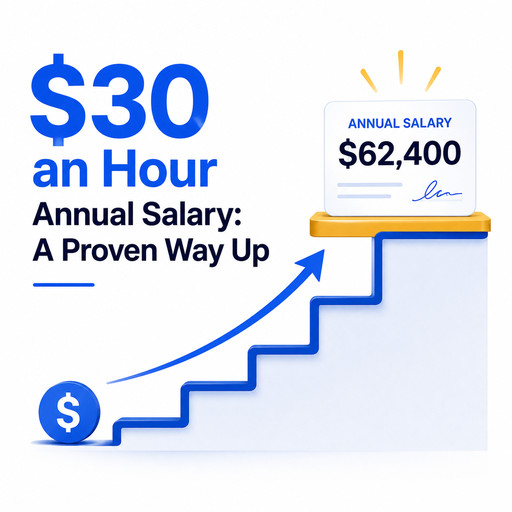
$30 an hour annual salary comes out to $62,400 a year. That’s the quick answer, here’s what it actually means for you, plus how to earn more if that number feels low
$30 an Hour Annual Salary: The Quick Answer
$30 an hour comes out to $62,400 a year. This is based on a 40 hour week, worked for 52 weeks.
Here’s the math: $30 × 40 hours × 52 weeks = $62,400.
That’s your gross pay. Gross means before taxes come out. This math uses the standard 40-hour workweek that the US Department of Labor treats as full-time for overtime purposes, which comes out to 2,080 hours a year. Here’s how it breaks down by pay period:
- Monthly: $5,200
- Biweekly: $2,400
- Weekly: $1,200
- Daily: $240
Taxes will take a chunk out of this. Once federal tax, Social Security, and Medicare come out, most single workers keep between $50,000 and $52,000 a year. Your exact number depends on your state and how you file your taxes.
Other Common Hourly to Salary Conversions
Checking a $30 an hour annual salary? You might want to know a few nearby numbers too. Here they are..
$27 an Hour Is How Much a Year?
$27 an hour comes out to $56,160 a year ($27 × 40 × 52). That’s about $4,680 a month. It sits just under $30 an hour, and a bit below the national median wage.
$50 an Hour Is How Much a Year?
$50 an hour comes out to $104,000 a year ($50 × 40 × 52). That’s $8,666 a month. This puts you past the six figure mark, a common goal when moving from a mid level job to a senior one.
$65k a Year Is How Much an Hour?
A $65,000 salary works out to about $31.25 an hour ($65,000 ÷ 2,080 hours). That’s just above the $30 an hour we started with.
$45k a Year Is How Much an Hour?
A $45,000 salary works out to about $21.63 an hour ($45,000 ÷ 2,080 hours). This is a common starting pay for entry level jobs.
Is $30 an Hour Actually a Good Salary?
The number alone doesn’t tell you much about a $30 an hour annual salary. So let’s look closer.
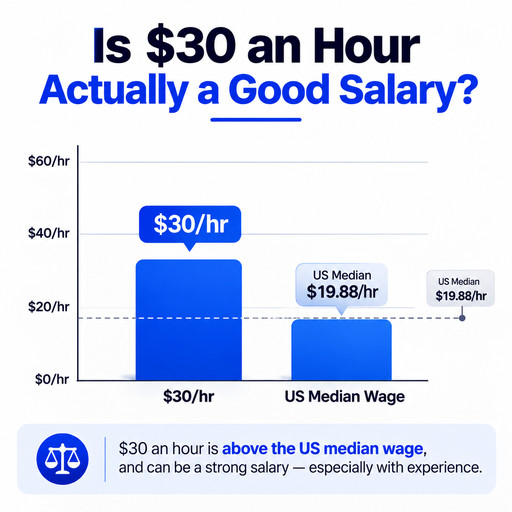
The number alone doesn’t tell you much. So let’s look closer.
$62,400 a year sits just below the current US median wage for full-time workers, as reported by the Bureau of Labor Statistics. So $30 an hour lands you right in the middle, not at the bottom, not near the top. It’s a solid, ordinary wage.
But “good” depends a lot on where you live. In a cheaper city, $30 an hour can cover rent, savings, and still leave room to breathe. In an expensive city, that same $62,400 might barely stretch, especially once rent eats up a third of your check.
Jobs that often pay close to $30 an hour include teachers, licensed electricians, nurses early in their careers, project coordinators, and skilled trade workers. If you’re in one of these jobs and $30 an hour still feels tight, that’s usually about your city or your years of experience. It’s not a sign you picked the wrong field.
So here’s the real question: is $30 an hour good for someone with your skills and experience? Or is it just the number you happened to land on?
Why You Might Be Stuck at This Rate
If you searched this because you feel you should be earning more than a $30 an hour annual salary, you’re probably right.
Here are a few common reasons people get stuck at $30 an hour longer than they should.
Your resume isn’t making it past the first screen. Most companies use software called an Applicant Tracking System, or ATS, to sort through applications before a human even looks at them. If your resume uses general words instead of the exact terms from the job post, the ATS can skip right past you, even if you’re fully qualified for the job. Here’s how AI resume tailoring fixes this.
You’re applying to jobs by hand, and it’s eating your time. Rewriting your resume for every job takes real time. So most people do one of two things. They burn out and stop applying as often. Or they send the same resume everywhere and wonder why nobody calls back.
You don’t have enough interviews lined up to negotiate. One job offer gives you little room to push back on pay. You mostly have to take what’s given. Three offers at once? Now you have real room to negotiate.
Interviews themselves trip people up. Even skilled, qualified people freeze up or ramble under pressure. A strong resume that lands you an interview won’t help much if the interview itself falls flat.
None of this means something is wrong with you. These are fixable problems, not personal flaws.
How to Actually Move Past $30 an Hour
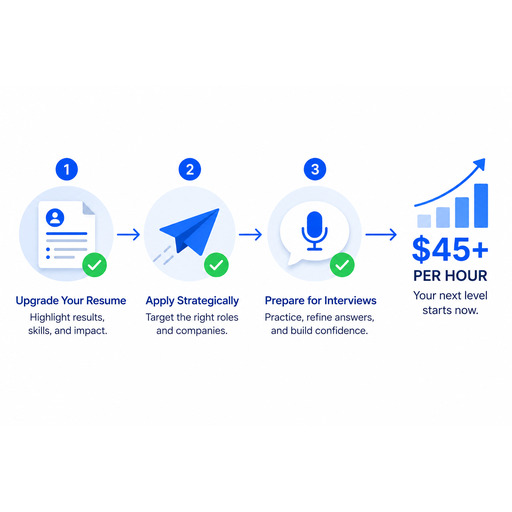
Fix the Resume ATS Systems Are Rejecting
The quickest fix most people can make is getting their resume seen in the first place. That means matching your resume’s wording to each job post’s exact keywords and requirements, not just listing your experience in general terms and hoping it’s close enough.
Lightforth’s Resume Builder does this for you, whether you’re stuck at a $30 an hour annual salary or aiming higher. Upload your resume once. Then, for each job you apply to, it adjusts your wording to match what that employer’s ATS is actually scanning for. It’s the difference between a resume that describes you and one that’s built to get past the first filter.
Stop Manually Applying to Every Job
Say tailoring one resume takes 20 minutes. Applying takes another 10. Now say you need to apply to 20 jobs a week for a real shot at something better. That’s over 10 hours a week, on top of a job you already have.
Lightforth’s Auto-Apply feature handles this part for you. Set your job preferences once. It then searches sites like LinkedIn, Indeed, and Glassdoor for roles that fit, and applies on your behalf. This is what makes applying at real volume possible, without turning your job search into a second job.
Walk Into Interviews Ready, Not Rattled
Landing the interview only helps if you can perform once you’re in it. Speaking your answers out loud, with real follow-up questions, builds a different kind of readiness than just reading sample answers off a page.
Lightforth’s Interview Prep gives you voice-based mock interviews with feedback in real time. It’s built around the STAR method, a simple way to structure your answers using four parts: Situation, Task, Action, and Result. This means you’re practicing the actual skill of answering under pressure, not just memorizing lines. Then, during the real interview, Interview Copilot gives you live support, right when nerves usually hit hardest.
Each of these three tools solves one piece of the same problem. A good salary listed on a job post doesn’t mean much until it’s actually in your bank account. Closing that gap takes more than hoping your next application lands.
Start Moving Up Today
“A $30 an hour annual salary is a decent place to be. But it’s not the ceiling.
If you’re ready to see what a higher rate could look like for you, Lightforth’s full platform can help. Resume Builder, Auto-Apply, Interview Prep, and Interview Copilot work together to move you from where you are now to your next offer, without the guesswork.
Activate Pro for $10 and get full access before it renews at $49 a month. Not ready to commit yet? Start with your 5 free monthly credits and try the platform at your own pace.
Either way, remember this: the number on your paycheck isn’t set in stone. It’s just where you’re starting from.
Is $30 an hour good in Canada?
Yes, roughly. As of 2026, the median hourly wage for full-time workers in Canada sits around CAD $30.50, according to Statistics Canada. That means CAD $30 an hour lands almost exactly at the national median, a solid, typical wage, not high, not low. Like in the US, how far it stretches depends heavily on the province and city, with Toronto and Vancouver costing noticeably more than smaller cities.
How much hourly is 100k a year?
$100,000 a year works out to about $48.08 an hour, based on a standard 2,080-hour work year (40 hours a week for 52 weeks). That’s calculated as $100,000 ÷ 2,080 hours.
How much money is $30 per hour?
$30 an hour comes out to $62,400 a year before taxes, or about $5,200 a month, $1,200 a week, and $240 a day, assuming a full 40-hour workweek. After taxes, most single filers take home closer to $50,000–$52,000 a year.
What jobs pay around $30 per hour?
Roles like teaching, licensed electrical work, early-career nursing, project coordination, and various skilled trades commonly pay in this range. It’s a common mid-level wage across many fields, not tied to one specific industry.
Is $65,000 a year a good salary?
Generally, yes. $65,000 a year works out to about $31.25 an hour, which sits slightly above the current US median wage for full-time workers. Whether it feels “good” day to day still comes down to your location and cost of living, but on a national scale, it’s an above-average income.