Book Appointment Now

AI Resume Tailoring: A Proven Way to Get Hired

It’s 11 p.m. and you’re refreshing your inbox for the tenth time tonight, wondering what’s actually wrong with you. You’re not lazy. You’re not unqualified. You’ve just been applying blind, and nobody told you the quiet reason five people got interviews this week while you got silence. AI resume tailoring is that reason. It’s the invisible line between resumes that get opened and resumes that get buried, and once you understand what AI resume tailoring actually does, you’ll never send a resume out cold again.
If you have ever felt talented and invisible at the same time, this article is for you. It doesn’t matter if you’re switching careers, moving to a new country, coming back from a break, or you just freeze up the second an interviewer asks “tell me about yourself.” The problem is rarely your experience. It’s usually the translation layer between your experience and the person deciding whether to call you.
Let’s fix that.
First, let’s kill a myth that’s costing people sleep
You’ve probably read that 75% of resumes get rejected by AI before a human ever sees them. That number is everywhere. It’s also fake.
Career researchers traced it back to a small resume company that shut down over a decade ago, with no study behind the claim at all. Enhancv’s 2025 interview with 25 US recruiters found that 92% of recruiters do not set up rules that auto-reject resumes based on content. What actually blocks you before a human looks at your file are “knockout questions” the employer sets, things like “must have a work permit” or “must have 5 years of experience.” Those are hard requirements, not hidden robot judgment.
Here’s what’s actually true: Applicant Tracking Systems (ATS) mostly rank and sort, they don’t secretly delete you. The real danger is your resume getting misread or buried low in the pile because of bad formatting, missing keywords, or a layout the software can’t parse cleanly. A 2026 parsing test of 48 resumes found that resumes saved as an image lost the candidate’s name, email, and phone number every single time. You’re not being rejected. You’re being made unreachable.
That distinction matters, because it tells you exactly what to fix.
What AI resume tailoring actually does
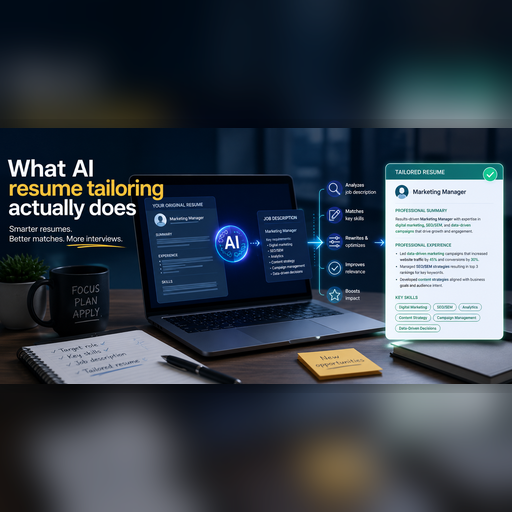
AI resume tailoring means using software to compare your resume against a specific job post, then adjusting your wording, skills, and bullet points so the match is obvious, both to the software scanning it and to the person reading it after.
Good tools do three things well:
They catch keyword gaps. If the job post says “stakeholder management” and your resume says “worked with clients,” the system flags that mismatch. ATS software often reads literally, not by meaning, so this step alone can be the difference between getting ranked and getting buried.
They turn duties into achievements. “Managed social media” becomes “grew Instagram engagement 40% over six months by testing content formats weekly.” Numbers and outcomes read better than job descriptions copied from your old title.
They save you from starting over every time. Instead of rewriting your whole resume for every application, you keep one strong base resume and let the tool adjust it per role.
That’s the upside. Now the part almost nobody talks about.
What nobody tells you about these tools
They can make you sound like someone else. AI can suggest a skill or a phrase that stretches what you actually did. If a tool invents an achievement you can’t back up in an interview, you’ll get caught, and that’s worse than a generic resume. Read every suggested line before you accept it. Ask yourself: could I explain this in detail to a stranger tomorrow?
Optimized for the bot can mean rejected by the human. A resume stuffed with exact-match keywords can read stiff and robotic once an actual person opens it. Recruiters are getting good at spotting resumes that were clearly auto-generated with no editing. The fix is simple: run it through AI, then read it out loud yourself and fix anything that doesn’t sound like you.
Some hiring systems now flag AI-written text. This is an early trend, not a settled fact, but it’s worth knowing it exists. The safest move is to let AI draft and you edit, not the other way around.
Your resume data goes somewhere. You’re uploading your work history, contact details, and sometimes salary information to a third-party platform. Before you commit to a tool, check its privacy policy for what it does with your data, whether it’s shared with other companies, and whether it’s used to train other models. This takes five minutes and it’s worth doing before your information is anywhere you can’t get it back.
Price adds up fast if you’re applying to a lot of roles. A $30-a-month plan feels cheap until you count how many resumes you’re actually tailoring with it. If you’re applying to 40 jobs a month, that’s under a dollar per application. If you’re only applying to five, the math looks very different. Work out your real cost per application, not just the sticker price, before you commit.
Not every job needs heavy tailoring. If you’re applying through a referral, or you’re going for a senior or niche role where a person reads your resume first, keyword-stuffing for a bot barely matters. Save the deep tailoring for roles you’re applying to cold, through a job board.
Tailoring doesn’t work the same way in every field
Your resume’s starting point depends a lot on your industry, and treating every field the same is a mistake most tools and most articles make. Roles in sales, healthcare, and marketing tend to score lower on first-pass keyword matching, mostly because job posts in those fields use more varied language for the same skill. One company writes “patient care coordination,” another writes “case management,” and they mean close to the same thing. Finance and executive resumes tend to start higher, since those job posts lean on more standardized terms.
What this means for you: if you’re in a field with a lot of language variation, spend more time on the keyword-matching step, since small wording differences cost you more there. If you’re in a field with standardized language, spend more of your time on the human-readability step instead, since your resume is already likely to clear the first pass and the person reading it next is your bigger hurdle.
What you should actually be doing
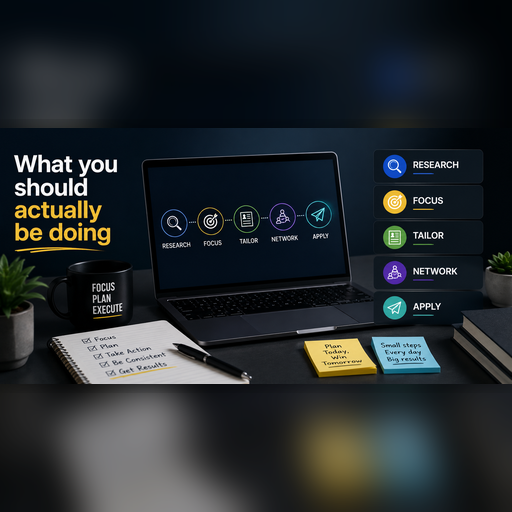
Here’s the checklist that matters, without the fluff:
- Build one strong master resume first. List everything, every project, every number, every skill, before you tailor anything. This is your source material.
- Test your current resume as a baseline. Run your untailored resume against a real job post first, so you know your starting point.
- Let AI draft, you edit. Never submit an AI-tailored resume without reading every line yourself.
- Use exact terms from the job post, not just synonyms. If they say “Python,” don’t write “coding languages” and expect it to match.
- Keep your file simple. One column, standard section headers (Work Experience, Education, Skills), no tables, no text boxes, no scanned images. This alone fixes most of the “invisible resume” problem.
- Name your files clearly, something like YourName-Resume-CompanyName works fine, so you’re not sending the wrong version by accident.
If interviews make you freeze
Getting the interview is only half the fight. A lot of qualified people lose the room the second the conversation starts, not because they lack answers, but because nerves scramble their thinking on the spot.
If this is you, practice out loud, with a real back-and-forth, not just notes in your head. Reading answers silently doesn’t train the part of your brain that has to perform live under pressure. Speaking them out loud does. The STAR method (Situation, Task, Action, Result) gives you a structure to lean on when your mind goes blank. Instead of trying to remember a whole story, you just fill in four boxes: what was happening, what you needed to do, what you did, and what happened because of it.
AI-powered mock interviews that respond in real time are worth using here, because they force you to speak the answer, not just plan it. A good one will ask a follow-up question based on what you actually said, the same way a real interviewer would, instead of running through a fixed script. That’s a closer rehearsal for the real thing than reading interview questions off a list.
If you’re job hunting from another country
If you’re an immigrant or you’re on a visa, your resume has one more job to do: it needs to make your work authorization status clear and correct, without you guessing at the legal language. Don’t leave employers uncertain about whether they can hire you. State your status plainly (for example, “Authorized to work in the US” or your specific visa category) if the job post asks for it.
For the real rules on who can work and what documents apply to your situation, use USCIS directly, not a blog, not a forum. Their Employment Authorization page is the official source, and it’s free.
The real cost of doing this alone
Add up what a tailored job search actually takes: rewriting your resume for each role, drafting a new cover letter, practicing answers to questions you can’t predict, tracking who you applied to and when, and doing it all again the next day. That’s not a resume problem anymore. That’s a full-time job on top of your job search.
This is where a single tool that handles the whole pipeline, not just one piece of it, starts to make more sense than juggling four separate subscriptions.
Where Lightforth fits in
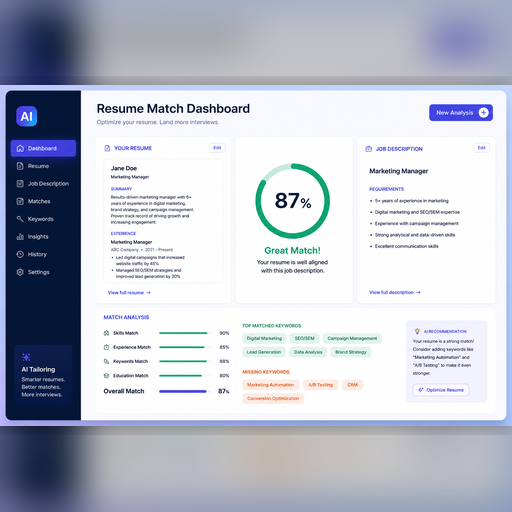
Lightforth is built around the exact gap this article has been pointing at: AI resume tailoring alone isn’t the finish line. It’s one part of a search that also includes applying, tracking, and surviving the interview.
Here’s what it actually does, piece by piece:
AI Resume Tailoring. You upload your resume once. Then, for each job you’re interested in, you paste the job description and Lightforth adjusts your resume to match what that specific employer is looking for. That is the keyword-matching step this whole article has been about, done for you instead of by hand.
A free ATS checker. Before you even apply, you can check how well your resume reads to ATS software, which takes the guesswork out of whether your formatting is working against you.
Auto-Apply. Set your job preferences once, and Lightforth searches boards like LinkedIn, Indeed, and Glassdoor for matching roles and submits applications on your behalf, solving the volume problem that makes tailoring every resume by hand unrealistic.
Interview Prep and Copilot. A voice-based mock interviewer gives you practice and feedback using structures like the STAR method, which speaks directly to anyone who freezes up under pressure. The Interview Copilot then gives you real-time guidance during your actual live interview.
Lightforth says it has helped thousands of job seekers move faster through the hiring process, including people who’d been applying for months with no response before switching tools. Those are the platform’s own reported outcomes, and like any vendor claim, worth verifying against your own results as you use it, which is easy to do, since you can track your applications and interview invites directly in the dashboard.
If you’ve read this whole article nodding along, tired of rewriting resumes by hand, tired of silence after applying, nervous about the next interview, this is the tool built for exactly that stack of problems, not just one of them.
Your next move
You don’t need twelve tabs open comparing tools. You need one resume that’s actually built for the job you want, sent to more of the right roles, and backed by practice that gets you ready to talk about it with confidence.
Get started with Lightforth for free and put your resume to work for you instead of against you.
How do you use AI to get your resume noticed?
Paste your resume and the job description into an AI tool that compares the two. The tool will flag missing keywords, weak bullet points, and skills you have but didn’t mention. Fix those gaps, keep your formatting simple (one column, standard headers, no tables or images), and read the final version out loud before you send it. That combination gets you past the software and gets a human to actually stop scrolling.
Which AI is better for resume tailoring?
It depends on what you need. Tools that only score your resume against a job post are fine if you just want a quick check. But if you’re applying to many jobs, you need something that also applies for you and preps you for interviews, not just a single scoring tool. Lightforth covers all three (tailoring, applying, and interview prep) in one place, which saves you from juggling separate subscriptions for each step.
How do you get AI to tailor a resume?
Upload your full resume first, one that lists every project, number, and skill you have. Then paste in the specific job description you’re applying to. The AI will match your experience against that posting and suggest changes: added keywords, rewritten bullet points, and a reordered skills section. Review every suggestion before you accept it. Don’t submit anything you can’t personally explain in an interview.
Is it okay to use AI to tailor a resume?
Yes. Using AI to match your real experience to a job description is no different from using spell check or a template. It becomes a problem only if the AI adds skills or achievements you don’t actually have. Keep the facts yours and let AI handle the wording and formatting, and you’re on solid ground.
Can recruiters tell if your resume was written entirely by AI?
Sometimes. A resume with no editing often reads stiff, repeats the exact same phrasing pattern in every bullet, and feels generic. Some hiring systems are also starting to flag text that looks machine generated. The fix is simple: let AI draft it, then rewrite a few lines in your own voice so it still sounds like you, not a template.