Book Appointment Now

How to Write About Me in Resume: A Clear, Simple Guide
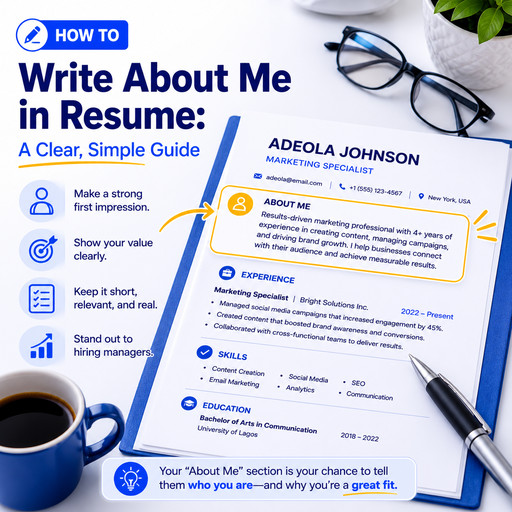
“How to write about me in resume is one of the most Googled resume questions out there, and for good reason. You know something needs to go in that space, but everything you type either sounds too stiff, too vague, or like it could belong to anyone.
This guide cuts through that. You’ll know exactly what to write, whether you even need this section at all, and what to avoid so you don’t accidentally work against yourself.
What Is the “About Me” Section on a Resume?
It’s a short introduction near the top of your resume, usually two to five sentences, that gives a hiring manager a quick sense of who you are professionally and what you bring to the role.
Think of it as a handshake in text form. It’s not your life story. It’s a focused, professional snapshot that makes someone want to keep reading.
It sits close to a professional summary, but with a slightly more personal tone. A professional summary sticks to qualifications and hard experience. An “About Me” section can also touch on your working style or motivations, which makes it a better fit for some candidates than others.
Do You Actually Need an “About Me” Section?
Not always. For some candidates, skipping it is the smarter move.
Use one if you are:
- A recent graduate or first-time job seeker. If your work history is thin, this section lets you add context about your goals and transferable skills without padding your experience.
- A career changer. Moving into a new field? A brief “About Me” section can explain why, so a recruiter doesn’t have to guess what your background has to do with the role.
- A freelancer or creative. Designers, writers, and marketers can use this space to reinforce their personal brand in a way a standard summary doesn’t allow.
Skip it if you are:
- An experienced professional with five or more years of relevant work history. At that point, a sharp professional summary does more in the same space, because recruiters and ATS software (more on that below) want your qualifications matched to the role, not a general personal introduction.
How to Write About Me in Resume: Step by Step”
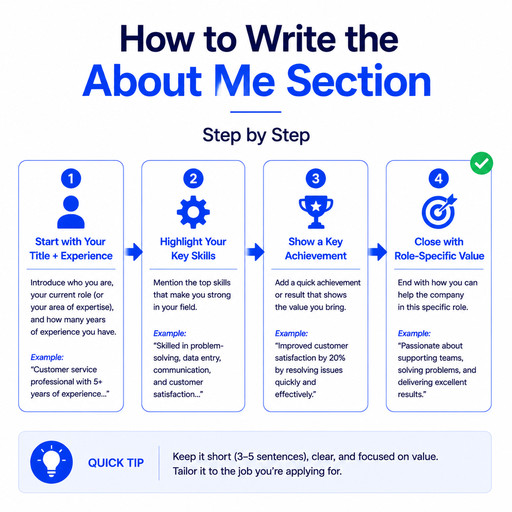
Start With Your Professional Title and Experience
Open with who you are professionally and how long you’ve been doing it. One sentence. It anchors everything that follows.
Example: “Marketing coordinator with 3 years of experience supporting digital campaigns for B2C brands.”
If you’re a recent graduate with no full-time experience yet, use your student status and any relevant training or projects. Example: “Final-year business student with hands-on experience in data analysis and customer service through two internships.”
Add Two or Three Relevant Skills
Pull these directly from the job posting. If the description says “stakeholder communication” or “project coordination,” use those exact words, not close alternatives. ATS software (the automated tool most companies use to filter resumes before a human sees them) reads literally. A resume that mirrors the job description’s actual language gets ranked higher in that first filter.
Keep it to two or three skills. A list of eight in a summary just looks like you’re throwing everything at the wall.
Include an Achievement, or What to Do If You Don’t Have One
If you have a measurable result, use it. Example: “Managed a campaign that grew email open rates by 34% over three months.”
If you don’t have a clear number to point to, that’s okay. Describe the scope of your work or a specific outcome instead. Example: “Supported a team of five through a full product launch cycle, handling scheduling, communications, and post-launch reporting.” That’s specific, honest, and far more useful than “hard-working team player.”
End With What You Bring to This Specific Role
This sentence is the one most people skip. It’s also the one that separates a forgettable summary from one that actually lands.
Don’t write: “Looking for an opportunity to grow.”
Do write: “Eager to bring content strategy experience to a fast-growing SaaS team focused on product-led growth.”
Check the company’s job ad, their website, or their mission statement. Find a specific phrase to mirror here. It shows you actually read the posting, not just copied a template.
What Heading Should You Actually Use?
The label “About Me” is casual, and on a resume, casual can read as unfocused. Some ATS systems also struggle to categorize sections with non-standard headings, which means your content might not get weighted correctly even if the writing is strong.
Use “Professional Summary” if you have relevant experience. Use “Objective” if you’re entry-level or making a big career shift and need to explain your direction. Use “Profile” if you’re in a creative or freelance field where a personal voice fits the industry.
Save “About Me” for LinkedIn and portfolio sites, where a conversational tone is expected. On a resume, the heading is part of the first impression. Make it work for you.
“About Me” Resume Examples
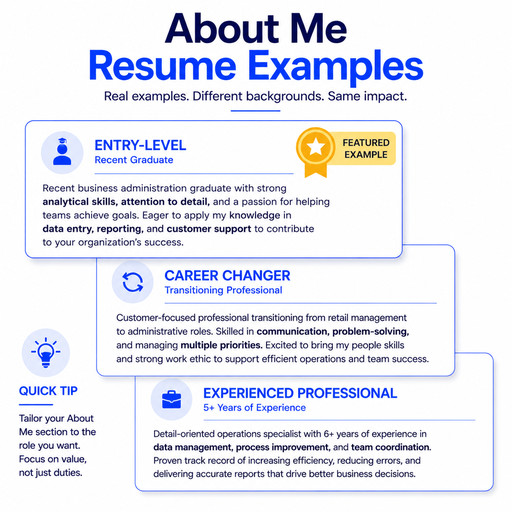
Entry-level candidate: “Motivated business administration graduate with experience in customer service, scheduling, and Microsoft Office Suite. During a six-month retail internship, consistently met weekly sales targets and trained two new team members. Seeking a junior operations role where strong organizational skills and a fast learning curve can support a growing team.”
Career changer: “Former secondary school teacher with 7 years of experience in curriculum design, public speaking, and large group facilitation. Transitioning into corporate training and L&D after developing and delivering a digital literacy program adopted across three schools. Bringing strong instructional design skills and a track record of measurable learner outcomes.”
Experienced professional: “Senior account manager with 10 years of experience in B2B SaaS sales across fintech and HR tech. Consistently exceeded annual quota by 20% or more, most recently closing a $1.2M enterprise deal. Looking to bring a consultative sales approach to a team focused on complex, long-cycle enterprise accounts.”
What to Avoid
Personal pronouns. Don’t open with “I am” or lean on “my” throughout. Write as if someone else is introducing you. “Experienced project manager with a track record of…” reads better than “I am an experienced project manager who…”
Buzzwords without backup. “Results-driven,” “passionate,” and “team player” mean nothing on their own. If you use an adjective, the rest of the sentence has to prove it with something specific.
Irrelevant personal details. Age, marital status, nationality, and hobbies don’t belong here. The only exception: a hobby that directly demonstrates a relevant skill, like a YouTube channel that proves video production ability for a marketing role.
Copy-pasted templates. If your summary could describe any candidate in your field, it’s not helping you. Every sentence should include at least one detail that’s true only for you.
How Lightforth Helps You Get This Right
Writing a strong “About Me” section is one part of the problem. The harder part is making sure that section is matched to each specific job you apply to, because a great summary for one role can be the wrong summary for another.
Lightforth’s Resume Builder handles that tailoring for you. You write your base resume once. For each job you apply to, it adjusts your summary and keywords to match what that specific employer’s ATS is scanning for. No more rewriting your introduction from scratch every time you apply somewhere new.
And once you start landing interviews, Lightforth’s Interview Prep and Interview Copilot take over from there, helping you bring the version of yourself on paper to life in the actual room.
Resume Builder, Auto-Apply, Interview Prep, and Interview Copilot together cover the full path: from a resume that gets read to an offer you’re ready to accept.
Start With a Resume That Actually Gets Read
A well-written “About Me” section can be the difference between a hiring manager reading all the way through your resume, or closing it after the first line.
Activate Pro for $10 and let Lightforth’s Resume Builder tailor your resume introduction to every job you apply for, before it renews at $49 a month. Not ready to commit yet? Your 5 free monthly credits are there whenever you want to test it yourself, no pressure.
How do I write about me in resume examples?
Start with your job title and years of experience, then add two or three relevant skills pulled directly from the job posting, one specific achievement or outcome, and a closing sentence about what you bring to this particular role. For example: “Customer service specialist with 4 years of experience handling high-volume inbound support for e-commerce brands. Reduced average resolution time by 22% through process improvements. Looking to bring strong client retention skills to a fast-growing SaaS team.” That structure works for most candidates across most industries.
What should I write about myself on my resume?
Stick to what’s professionally relevant: your title, experience level, key skills, one measurable result if you have one, and what you’re looking for in this specific role. Leave out personal details like age, hobbies, or relationship status unless a hobby directly supports the job. Everything in this section should answer one question: why are you the right person for this specific role?
What is a good about me for a resume?
A good one is short, specific, and tailored. It reads like a confident introduction, not a list of buzzwords. It avoids vague phrases like “results-driven professional” and replaces them with something concrete, like “increased team output by 30% by streamlining the weekly reporting process.” Three to five sentences is the right length. Anything longer and recruiters start skimming.
How do I explain myself in a resume?
Write in the third person implicitly, meaning drop the “I” and write as if someone else is introducing you. Start with an adjective or your job title, move into your experience, name your most relevant skills, and close with what you bring to this specific role. Read the job posting carefully before you write a single word, since every phrase in your summary should connect to something the employer actually asked for.
What is the difference between an “About Me” section and a professional summary?
A professional summary focuses purely on your qualifications, skills, and experience as they relate to the job. An “About Me” section allows a slightly more personal tone, touching on your values, motivations, or working style. In practice, most experienced candidates do better with a professional summary since it’s what ATS systems and recruiters expect. The “About Me” label works better on LinkedIn or a portfolio site than on a formal resume.