Book Appointment Now

$25 an Hour Is How Much a Year? Your Best Next Step

$25 an hour is how much a year? Here’s the fast, clear answer, plus what it actually means for your paycheck.
Table of Contents
$25 an Hour Is How Much a Year? The Quick Answer
$25 an hour comes out to $52,000 a year. That’s based on a standard 40-hour week, worked for 52 weeks.
Here’s the math: $25 × 40 hours × 52 weeks = $52,000.
That’s your gross pay, before taxes. Here’s how it breaks down by pay period:
- Monthly: $4,333
- Biweekly: $2,000
- Weekly: $1,000
- Daily: $200
Once federal tax, Social Security, and Medicare come out, most single filers take home somewhere between $40,000 and $42,000 a year. Your exact number depends on your state, your filing status, and any deductions you claim, so treat this as a solid estimate, not an exact figure.
Other Common Hourly to Salary Conversions
Checking $25 an hour? A few nearby numbers are worth knowing too, especially if you’re weighing this against other offers or roles.
$35 an hour is how much a year? That comes out to $72,800 a year ($35 × 40 × 52), or about $6,066 a month. This sits well above the median wage. It often marks the jump from entry-level work to a specialized or skilled role, think licensed trades, mid-level technical jobs, or early management.
$45 an hour is how much a year? That works out to $93,600 a year ($45 × 40 × 52), or roughly $7,800 a month. At this rate, you’re closing in on six figures. That usually points to senior, highly specialized, or supervisory work.
Seeing where $25 an hour sits next to these numbers can help you set a real target for what’s next, instead of guessing at what “more” actually looks like.
Is $25 an Hour Actually a Good Salary?
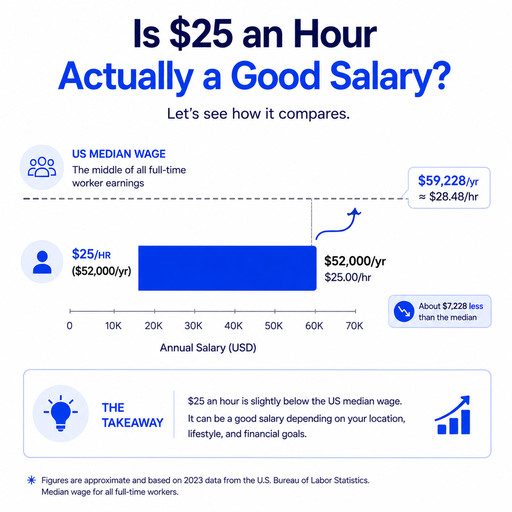
Here’s where the number needs real context, not just a yes or no. Knowing that $25 an hour is how much a year matters less than knowing whether that number actually works for your life.
$52,000 a year sits below the current US median wage for full-time workers, reported by the Bureau of Labor Statistics. That puts $25 an hour at roughly 80% of that median. It’s a workable wage, but not a comfortable middle-ground one, especially outside lower cost-of-living areas.
Where you live changes this answer more than almost anything else. In a smaller city or a lower cost-of-living region, $52,000 a year can comfortably cover rent, groceries, and some savings. In a major metro area, the same salary can feel stretched thin, especially once rent alone eats up a third of your paycheck or more.
Common roles that pay around this rate include administrative assistants, customer service team leads, entry-level technicians, dental hygienists in some regions, and certain retail or hospitality management positions. If you’re in one of these roles and $25 an hour feels tight instead of comfortable, that’s usually not a sign you picked the wrong field. It’s more often a sign that your experience, location, or negotiating position hasn’t caught up to what you’re actually capable of earning yet.
Why You Might Be Stuck at This Rate
If you searched this because you suspect you should be earning more, that instinct is usually right. Here’s what’s commonly standing in the way.
Your resume isn’t making it past the first screen. Most companies now use software called an Applicant Tracking System, or ATS, to filter applications before a person ever sees them. If your resume uses general words instead of the exact terms from the job post, it can get filtered out or buried, even when you’re genuinely qualified for the role.
You’re applying by hand, and it’s eating your week. Tailoring a resume and cover letter for every posting takes real time and focus. Most people end up doing one of two things: they slow down and apply to far fewer roles than they should, or they send the same generic resume everywhere and quietly wonder why the callbacks never come.
You don’t have enough interviews lined up to negotiate. One job offer gives you very little room to push back on pay. You mostly have to take what’s given. Three interviews or offers happening at once is a completely different conversation, that’s when you actually have leverage.
Interviews are where it falls apart. Even genuinely strong, qualified candidates freeze up, ramble, or lose their footing the moment real pressure hits. A resume good enough to land the interview doesn’t help much if the interview itself doesn’t go well once you’re in the room.
None of this means something is wrong with you. These are fixable, mechanical problems, not personal flaws.
This is where Lightforth comes in. It’s built as one platform that handles the whole path from where you are now to where you want to be, tailoring your resume, applying on your behalf, and getting you ready for the interview itself, instead of leaving you to piece together separate tools for each step.
How to Actually Move Past $25 an Hour
Fix the resume ATS systems are rejecting. The fastest fix most people can make is getting their resume seen in the first place. Lightforth’s Resume Builder does this by matching your resume’s wording directly to each job posting’s specific keywords and requirements. It’s built to get past that first filter, not just describe your experience in general terms and hope it’s close enough.
Stop manually applying to every job. Say tailoring one resume takes 20 minutes, and applying takes another 10. Now say you’re trying to apply to a real number of jobs each week. That adds up to hours on top of a job you may already have. Lightforth’s Auto-Apply feature searches boards like LinkedIn, Indeed, and Glassdoor for roles that match your preferences, then applies on your behalf. That way, you can actually apply at the volume that moves the needle, instead of burning out after a handful of applications.
Walk into interviews ready, not rattled. Landing the interview only helps if you can perform once you’re in it. Lightforth’s Interview Prep gives you voice-based mock interviews with real-time feedback, built around the STAR method, so you’re practicing the actual skill of answering under pressure, not just reading sample answers off a page. During the real interview, Interview Copilot gives you live support right when your nerves usually hit hardest.
Each of these tools solves one specific piece of the same problem. A better number on paper doesn’t mean much until it shows up in your paycheck, and closing that gap takes more than hoping the next application lands.
From $25 an Hour to $30 an Hour and Beyond
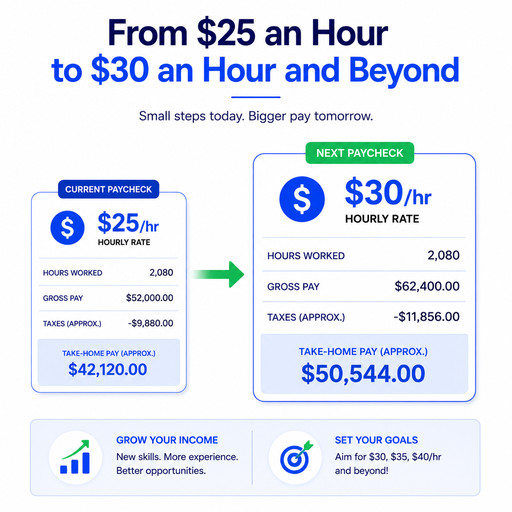
$25 an hour and $30 an hour aren’t two different worlds. They’re often just one well-tailored resume and a couple of strong interviews apart. If $30 an hour is your next real target, here’s exactly what that number looks like and how to get there.
Start Moving Up Today
$25 an hour is how much a year? A starting point, not a ceiling. The path from here to your next pay bracket is more within reach than it might feel right now.
Try it for yourself. Activate Pro for $10, before it settles into the regular $49 a month, and put Resume Builder, Auto-Apply, Interview Prep, and Interview Copilot to work on your next offer. Prefer to test the waters first? Your 5 monthly credits are there whenever you want to poke around, no commitment needed. And when you’re ready to go all in, upgrading to Pro is one click away.
How much is $100,000 a year per hour?
$100,000 a year works out to about $48.08 an hour, based on a standard 2,080-hour work year (40 hours a week for 52 weeks). That’s calculated as $100,000 ÷ 2,080 hours.
Is $25 an hour good in Canada?
It’s below average. As of 2026, the median hourly wage for full-time workers in Canada sits around CAD $30.50, according to Statistics Canada. That puts CAD $25 an hour noticeably below the national median, workable in lower cost-of-living provinces, but tighter in cities like Toronto or Vancouver.
Is $25 an hour $50,000 a year?
Close, but not exact. $25 an hour comes out to $52,000 a year based on a full 52-week work year. You’d land closer to $50,000 a year only if you factor in about 2 weeks of unpaid time off, working 50 weeks instead of 52 ($25 × 40 × 50 = $50,000).
What is $50,000 a year hourly in Canada?
A $50,000 annual salary works out to about $24.04 an hour, using the standard 2,080-hour work year ($50,000 ÷ 2,080). This math is the same in Canada and the US, since both use the same 40-hour, 52-week standard for full-time work.
Is $52,000 a year a good salary?
It depends mostly on where you live. $52,000 sits just below the current US median wage for full-time workers, so it’s a workable, middle-of-the-pack salary in lower cost-of-living areas, but can feel tight in expensive cities where rent alone takes up a large share of your paycheck.