Book Appointment Now

Assistant Revenue Officer: The Proven Path to Get Hired

Looking into becoming an Assistant Revenue Officer? You’ve probably noticed a problem already. Every job posting describes it a little differently. There’s no single place that puts the full picture together.
This guide does that for you.
We’ll cover what the job actually involves, what it pays at the entry level, the skills employers really look for, and how to build a resume and interview approach that gets you hired.
Table of Contents
What Does an Assistant Revenue Officer Actually Do?
An Assistant Revenue Officer supports the money side of an organization. That could mean a government agency, a local council, or a private company’s finance team.
Job titles vary a lot. You’ll see “Revenue Collection Officer,” “Assistant Revenues and Inspection Officer,” and a few others. But the core duties stay the same across almost every posting:
- Processing payments and refunds. You’ll handle incoming taxes, fees, or bills, and fix account errors when they come up.
- Keeping financial records accurate. Updating billing systems is a daily task here, not something you do once in a while.
- Answering questions from taxpayers or customers. People will call or email you about their bills, payment plans, and disputes.
- Writing routine reports. Most roles ask for daily or monthly collection summaries.
- Helping senior staff with assessments. This can include field data collection, property or business assessments, and paperwork for enforcement cases.
In short, this job mixes financial accuracy with talking to people directly. Keep that in mind. It matters a lot once you start building your resume.
Assistant Revenue Officer Salary: What to Actually Expect
Most entry-level revenue officer roles, which is where Assistant Revenue Officer positions usually sit, start around $34,800 a year in government jobs, based on the 2026 GS-5 federal pay scale, and can reach roughly $50,000 or more once locality pay is added at the GS-7 level in higher cost-of-living areas. Private sector roles can pay more, depending on the company and where you’re located.
One thing to watch for: this range is for entry-level and assistant roles specifically. Senior Revenue Officer positions, the kind with years of experience behind them, often pay a lot more. If you see much higher numbers while researching, that’s probably a senior role, not the one you’re applying for.
Check the specific job posting or agency’s pay scale when you can. Government jobs especially tend to publish exact numbers by grade and location.
Skills and Qualifications You Actually Need
Employers hiring for this role want a specific mix of skills, not just accounting know-how.
Financial accuracy and basic computer skills. You’ll need to feel comfortable with accounting or billing software, and be able to catch and fix errors in financial records.
A basic grasp of tax or compliance rules. You don’t need to be a tax expert. But you should understand how local tax rules or billing compliance work, especially for government-related jobs.
Clear, professional communication. A big part of this job is talking to people about their bills, sometimes in tense or disputed situations. This isn’t a job where you just sit at a desk all day.
Attention to detail. Small mistakes in financial records can turn into bigger problems later. Staying accurate through repetitive daily work is a real requirement, not just something to put on a resume.
How to Build a Resume That Fits This Role
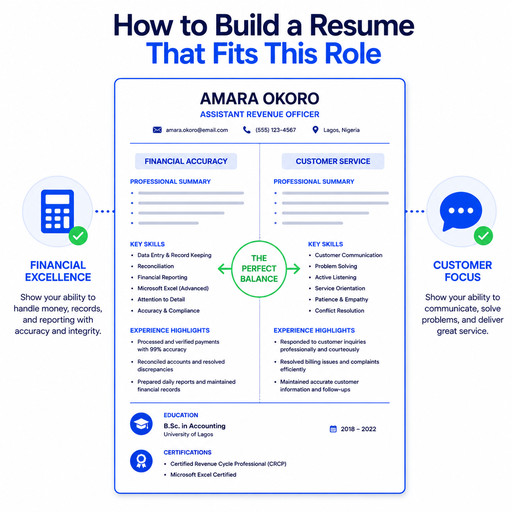
Here’s where a lot of candidates lose ground. It’s usually not because they lack the right qualifications. It’s because their resume doesn’t show this specific mix of skills clearly.
Show the Financial Accuracy Employers Screen For
Don’t just write “accounting software” as a skill. Show what you actually did with it. Instead of “Used billing software,” try something like “Processed and reconciled 200+ monthly payment records with zero errors.” Specific, measurable accuracy is what stands out here. Listing software names on their own isn’t enough.
Don’t Bury the Customer Service Side
Many finance-focused resumes underplay the customer-facing part of this job. But it matters just as much as the numbers. If you’ve resolved billing disputes, answered customer questions, or explained payment plans to frustrated people, say so clearly. This role needs both sides on your resume, not just the financial one.
Getting that balance right for every application is exactly what Lightforth’s Resume Builder helps with. It matches your resume’s language and focus to each specific job posting. That way, a role like this one, which blends finance and customer service, doesn’t get flattened into a generic accounting resume.
What to Expect in the Interview

Interviews for this role often include scenario-based questions, not just “tell me about yourself.” Expect things like:
- “Walk me through how you’d handle a taxpayer who disputes a billing error.”
- “Tell me about a time you had to explain a tough decision, like a denied payment plan, to someone who was upset.”
- “How do you stay accurate when you’re handling a lot of repetitive financial data?”
These questions test whether you can hold two things at once: precision and people skills. Practicing your answers out loud, with real follow-up questions, prepares you far better than reading sample answers off a list.
Lightforth’s Interview Prep gives you voice-based mock interviews with real-time feedback. It’s built around methods like STAR, so you practice the actual skill of answering under pressure, not just memorizing lines. During the real interview, Interview Copilot gives you live support right when your nerves are highest. That matters for a role where staying calm during a hard conversation is part of the job itself.
Applying at Volume vs. Applying Well
Government and council jobs like this one often open and close fast. Similar roles get posted across different agencies or municipalities at the same time. Applying to enough of them, while properly tailoring your resume for each one, takes real time. And you should be tailoring each one.
Lightforth’s Auto-Apply feature handles this part for you. It searches job boards for roles that match what you’re looking for and applies on your behalf. That way, your tailored resume actually reaches enough employers, instead of sitting untouched after one or two applications.
Start Preparing for Your Assistant Revenue Officer Interview Today
This role asks for more range than it usually gets credit for: financial precision, compliance knowledge, and direct contact with the public, all at once. Your application should show that clearly.
Activate Pro for $10 and get full access to Resume Builder, Auto-Apply, Interview Prep, and Interview Copilot, before it renews at $49 a month. Not ready to commit yet? Start with your 5 free monthly credits, or upgrade to Pro whenever you’re ready to move faster.
What are the responsibilities of a revenue officer?
A Revenue Officer’s core job is assessing and collecting taxes, fees, or other revenue owed to an organization or government agency. This includes reviewing financial records for compliance, identifying discrepancies, negotiating payment plans or settlements, and in some cases enforcing collection through wage garnishment or property liens. Senior Revenue Officers often also advise on tax strategy and stay current on changes in tax law.
What are the responsibilities of a revenue assistant?
An Assistant Revenue Officer handles the day-to-day administrative and financial support side of revenue collection. This means processing payments and refunds, maintaining accurate billing records, answering taxpayer or customer questions, preparing routine collection reports, and supporting senior staff with assessments or enforcement paperwork. It’s a more entry-level, execution-focused version of the Revenue Officer role.
What skills are needed to be a revenue officer?
Revenue Officers need strong knowledge of tax law and compliance regulations, sharp analytical skills for reviewing financial records, and confident negotiation ability for handling payment disputes or settlements. A background in accounting, finance, or a related field is typically required, along with comfort interviewing taxpayers directly, sometimes in tense situations.
What skills are needed for a revenue assistant?
Assistant Revenue Officers need solid computer literacy with accounting or billing software, careful attention to detail for keeping financial records accurate, and clear communication skills for handling customer inquiries. A working knowledge of local tax or compliance basics helps, but deep tax law expertise usually isn’t required at this level, that comes with seniority.
What’s the difference between a Revenue Officer and an Assistant Revenue Officer?
The core difference is scope and seniority. A Revenue Officer typically has more authority to negotiate settlements, pursue enforcement action, and advise on compliance strategy. An Assistant Revenue Officer supports that work at a more administrative level, handling payment processing, records, and routine customer contact. Many Assistant Revenue Officer roles serve as a direct stepping stone toward the full Revenue Officer position